

Learn About MRI
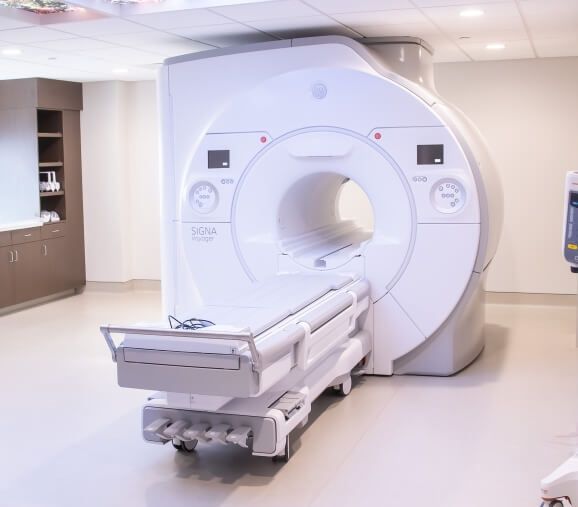
Norwalk Radiology Consultants with Stamford Health offers state-of-the-art imaging. Our full-service diagnostic center is dedicated to providing patients with the highest-quality personalized care at a lower out-of-pocket cost. Our MRI services are available Monday – Saturday, 7 a.m. - 8 p.m.
Our board-certified radiologists are highly trained in magnetic resonance imaging (MRI) to deliver accurate, detailed diagnostic information in a person-focused environment. MRI uses magnetic fields instead of radiation to take highly detailed pictures of the body. We have the latest in high-field strength magnets, which are scanners that fully surround the body so that optimal images are obtained. A referral from a physician is required to schedule an MRI appointment.
Once the images are taken, they are then interpreted by a radiologist. Results are provided to the patient by their referring physician who will discuss the results with the patient.
Our board-certified radiologists are highly trained in magnetic resonance imaging (MRI) to deliver accurate, detailed diagnostic information in a person-focused environment. MRI uses magnetic fields instead of radiation to take highly detailed pictures of the body. We have the latest in high-field strength magnets, which are scanners that fully surround the body so that optimal images are obtained. A referral from a physician is required to schedule an MRI appointment.
Once the images are taken, they are then interpreted by a radiologist. Results are provided to the patient by their referring physician who will discuss the results with the patient.
-
What should you expect during an MRI?An MRI typically takes about 45 minutes. A patient will lie on a table that slides into the opening of the MRI machine. While the scan is in progress, there will be banging noises caused by the changing magnetic fields. Patients are allowed to listen to music during this time. The technologist will be able to talk to the patient through a microphone from outside of the room. Patients must remove all metal jewelry, hearing aids, watches, and other belongings before entering the room. Patients will also change into an MRI-safe gown.
If the MRI requires contrast, a patient will receive the contrast through an IV. -
What should you do if you have an implant or ICD device?While most modern-day pacemakers and ICD devices are approved for an MRI, if a patient has one of those devices or a metal implant, implanted drug infusion device, or occupational exposure to metal, the patient must disclose this information prior to scheduling the exam.
-
Do you need to do anything prior to the MRI?Patients with conditions that prevent them from staying still inside the MRI machine may need to have an MRI with anesthesia. This is also common for children since it is hard for them to stay still. Our care team will work with you to manage expectations.
-
Does insurance cover an MRI?Please discuss with your referring physician; all insurances offer different coverage, and some require prior authorization.